Miniature House vs Book Nook: Which One Should You Build First?
At first, a miniature house and a book nook can look almost like the same hobby.
Both may contain tiny shelves.
Both can have warm LED lights.
Both might show a miniature bookstore, café, greenhouse, bedroom, street, or fantasy world.
And both usually arrive in a box containing far more small pieces than the finished photograph suggests.
So if you are buying your first miniature kit, the choice can feel strangely difficult:
Should you start with a book nook or a miniature house?
The biggest difference is not simply where the finished model sits.
It is the kind of building experience each format tends to offer.
A book nook is traditionally a narrow, tall scene designed to sit between books on a shelf. A miniature house or room kit is usually a more open, freestanding scene designed to be viewed from the front and often from several sides. That basic shape influences everything from perspective and lighting to how much interior detail you can see. Recent miniature-community discussions describe the same distinction: a book nook is generally constrained by its bookshelf-insert shape, while miniature houses have far more freedom in their overall form.
But for a beginner, there is an even more useful difference.
Many modern book nooks feel more like 3D puzzles. Traditional miniature houses often feel more like miniature crafting.
That is not true of every kit.
But it is a very useful place to start.
Quick Answer: Book Nook or Miniature House for a Beginner?
If you have no miniature-building experience and mainly want a relaxing assembly project with a strong finished result, I would usually recommend starting with a beginner-friendly book nook with mostly pre-finished, snap-fit pieces.
If what attracts you to the hobby is the idea of actually making tiny furniture, books, plants, cushions, decorations, and rooms, a miniature house may be more satisfying—even if your first project takes longer.
Here is the simplest comparison:
| Book Nook | Miniature House | |
|---|---|---|
| Finished shape | Narrow bookshelf insert | Open freestanding room or house |
| Main viewing angle | Mostly from the front | Front plus more visible sides/interior |
| Typical beginner experience | Often more puzzle-like | Often more craft-like |
| Snap-fit construction | Common in modern kits | Depends heavily on the kit |
| Handmade details | Usually moderate | Can be extensive |
| Glue work | Often limited in newer kits | Can be substantial |
| Paper/fabric crafting | Usually less | Often more |
| Lighting | Important to the visual effect | Common, but varies |
| Display space | Very efficient | Usually needs more open shelf/desk space |
| Customization | Possible, but physically constrained | Usually more freedom |
| Best first choice if… | You want easier assembly and a quick visual payoff | You want the actual crafting process |
| Biggest beginner surprise | Tight press-fit pieces and wiring | How much tiny furniture/details you may need to make |
The interesting part is that neither one is automatically easier.
Construction style matters more than the name printed on the box.
What Is a Book Nook?
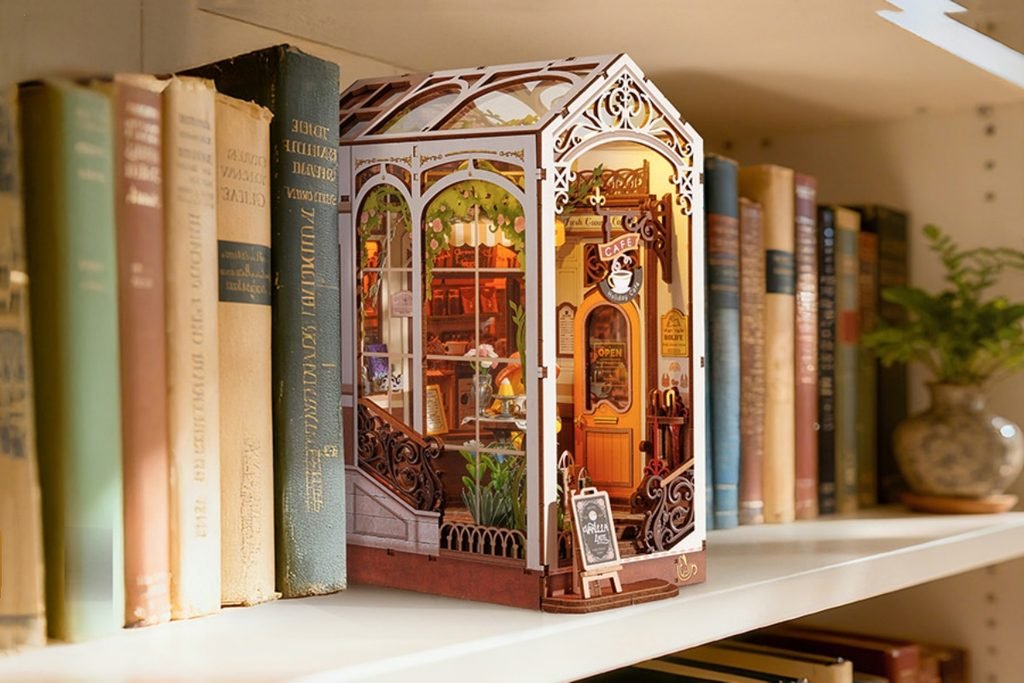
A book nook is essentially a tiny scene built inside a narrow vertical enclosure.
Its proportions are part of the idea.
Instead of displaying a miniature world on top of the bookshelf, you slide it between the books.
Viewed from the front, it can look like the shelf suddenly opens into another place:
a hidden alley,
a tiny library,
a railway platform,
a magical shop,
a forest path,
or a street disappearing into the distance.
The narrow format naturally encourages designers to use perspective.
Walls angle inward.
Lights pull your eye toward the back.
Mirrors may create the illusion of additional depth.
Doorways and arches frame the scene.
That is one reason book nooks can look so dramatic despite occupying relatively little space.
Community descriptions consistently define the traditional book nook as a narrow, book-shaped scene intended to sit between books, rather than simply “a miniature with books in it.”
What Is a Miniature House Kit?
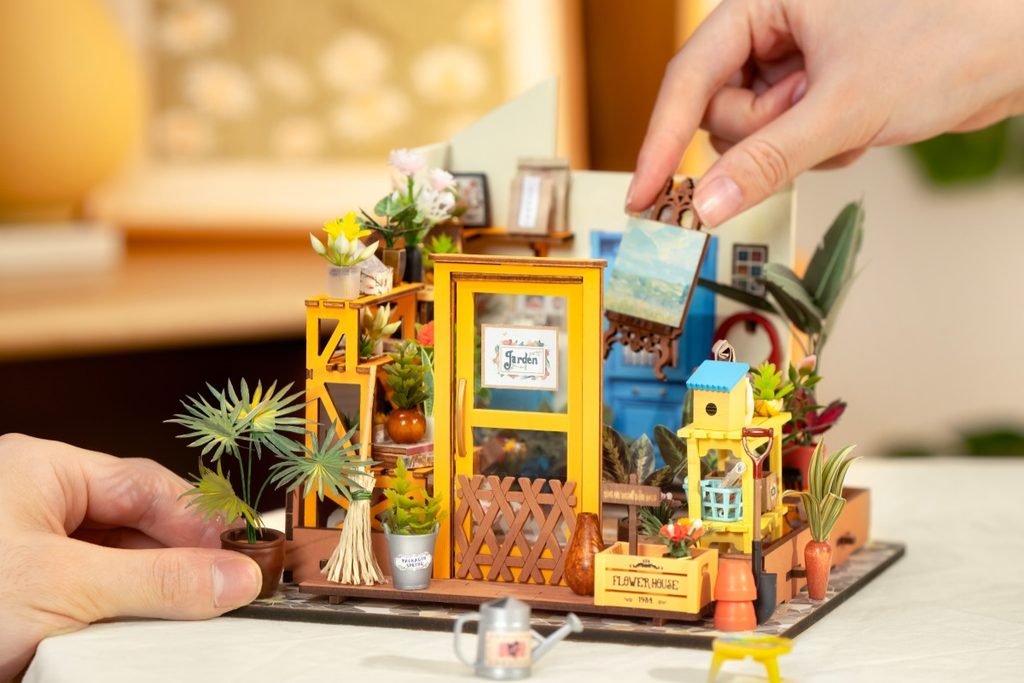
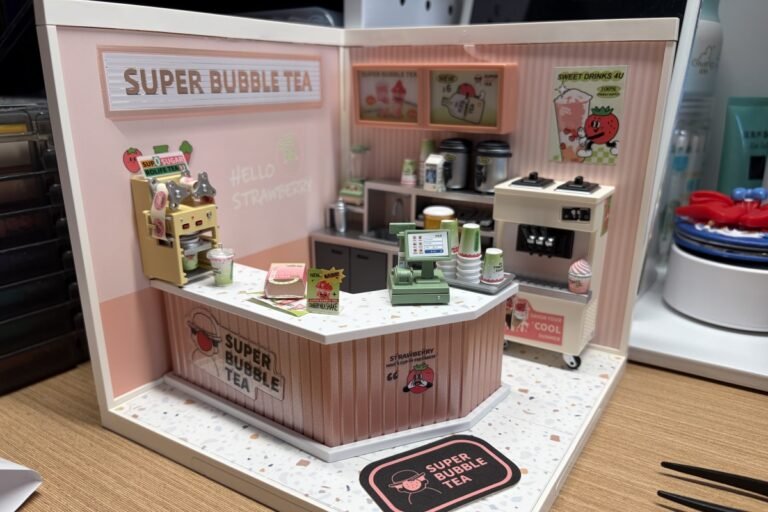
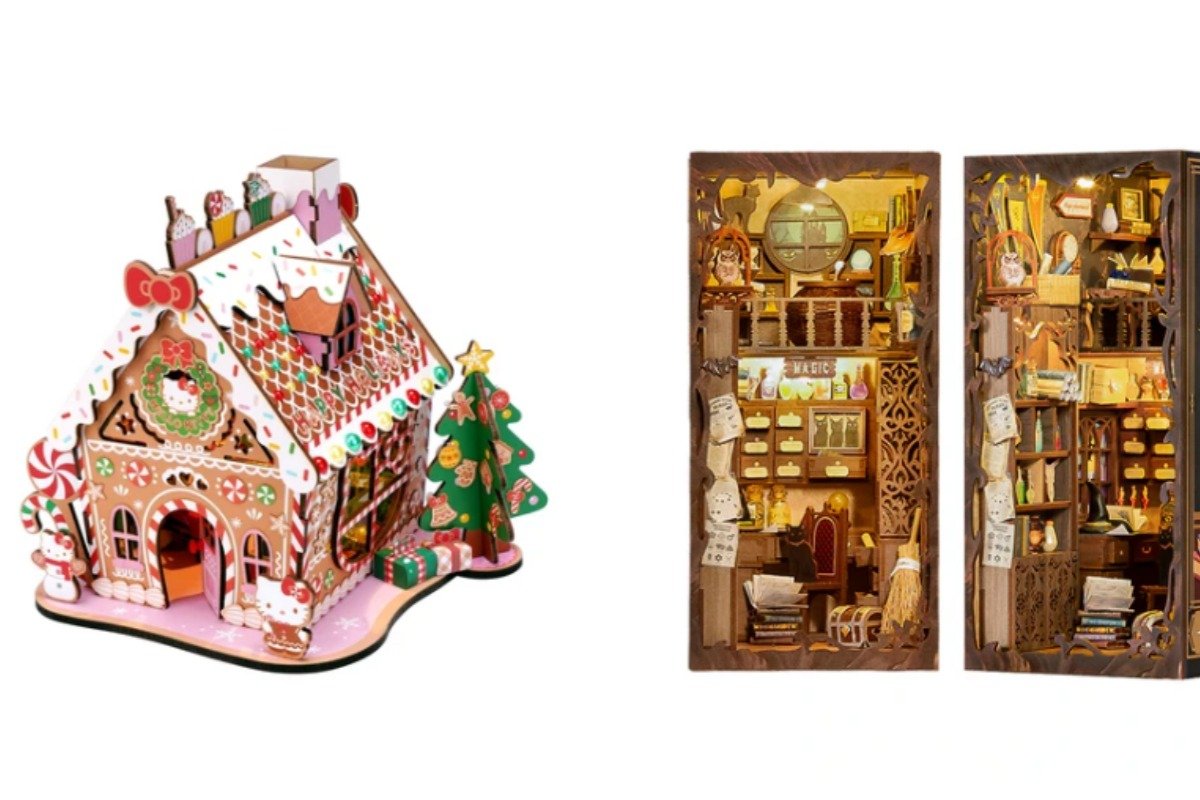
A DIY miniature house is usually a more open model.
It might actually look like a tiny house, but it can just as easily be:
a room,
a shop,
a café,
a greenhouse,
a studio,
or another open-front miniature scene.
Instead of creating the illusion that you are looking down a narrow passage, miniature houses tend to emphasize the objects inside the space.
You notice the sofa.
The books.
The plants.
The dishes on the table.
The curtains.
The tiny objects sitting on shelves.
And because more of the interior is exposed, the furniture itself often becomes a larger part of the building experience.
That is where the difference becomes important for someone choosing a first project.
The Most Useful Difference: Building vs Making
Imagine two projects showing a miniature bookstore.
In Book Nook A, the bookshelf may already be a laser-cut wooden component.
You press several pieces together, add printed books or stickers, install it into the scene, and continue.
In Miniature House B, the bookshelf itself may need to be glued together.
Then you cut and fold books.
Then glue them individually to the shelves.
Then make a tiny plant.
Then assemble a chair.
Then cut fabric for a cushion.
The finished scenes may look equally detailed in a photograph.
The work required to create that detail can be completely different.
This difference also appears clearly in hobby communities. Builders who work with both formats frequently describe modern book nooks as closer to 3D puzzles, while traditional room or house kits add considerably more miniature crafting.
That is why I would not ask which one is objectively better.
I would ask:
Which part sounds fun to you?
Choose a Book Nook If You Enjoy Assembling Things
If you like:
LEGO,
wooden puzzles,
model kits,
IKEA-style step-by-step assembly,
or simply the satisfaction of watching flat pieces gradually turn into a finished object,
a snap-fit book nook is a very natural introduction.
You still need patience.
You may still encounter:
tight wooden tabs,
tiny stickers,
LED wiring,
and pieces that require careful alignment.
But the project usually gives you fairly obvious milestones.
First the structure.
Then the interior.
Then lighting.
Then the exterior.
You can see progress quickly.
One recent first-time book-nook builder who already had miniature experience described finishing a project over a weekend and specifically noticed that book-nook construction involved much more pressing pieces together, whereas their miniature experience involved more gluing.
That distinction captures the experience surprisingly well.
Choose a Miniature House If Making Tiny Things Is the Part You Want
Maybe the thing that fascinates you is not putting walls together.
It is this:
making a lamp the size of your thumb,
folding a tiny magazine,
turning wire and paper into a plant,
arranging miniature food on a table,
or making a room look lived in.
In that case, I would not automatically steer you toward the easiest snap-fit book nook.
You may finish it successfully and still feel like:
“That was fun, but I wanted to make more of the miniature things myself.”
A traditional miniature house gives you more opportunities to do exactly that.
It is often slower.
It can be messier.
And glue control becomes much more important.
But the satisfaction is different.
You are not only assembling a miniature world.
You are manufacturing pieces of it.
Book Nooks Usually Give You a Faster Visual Payoff
One reason I like book nooks as a first project is that they often produce satisfying progress quite quickly.
A flat wooden sheet becomes a wall.
A wall becomes a corridor.
A few panels suddenly establish the architecture.
Then the LEDs switch on.
Even before every tiny decoration is installed, the project already looks like something.
That early visual progress matters for beginners.
The first miniature is when you are most likely to wonder whether you have chosen a hobby that is too fiddly.
Seeing the scene appear quickly can keep you moving.
A 2025 beginner discussion included people who had tried both formats and specifically recommended starting with book nooks before progressing to more complicated 3D miniature builds. One builder said they had initially become frustrated with a room-style miniature but found the snap-together book-nook experience much more satisfying.
That does not mean miniature houses are “too hard.”
It means the learning curve can be different.
Miniature Houses Often Teach You More Craft Techniques
The flip side is that a miniature house can teach you a much broader range of skills in one project.
By the end, you may have practiced:
precision gluing,
paper folding,
fabric work,
wire shaping,
tiny furniture assembly,
wood fitting,
lighting,
painting,
and decorative composition.
That makes traditional miniature kits an excellent bridge into more advanced miniature making.
Once you start customizing, those skills become even more valuable.
You stop asking:
“Where does this plant go?”
and start asking:
“What if I made a different plant?”
That is where kit building starts turning into miniature design.
If that sounds exciting rather than exhausting, a miniature house may be the better first choice for you.
Display Space Is More Important Than People Expect
This is one area where book nooks have a huge practical advantage.
They use space very efficiently.
A book nook occupies roughly the same kind of footprint as a thick book.
That makes it easy to fit into:
a bookshelf,
office shelving,
or a small collection.
A miniature house needs more visual breathing room.
Because the front and sometimes the sides are meant to be visible, placing it tightly between objects can hide the part you spent hours making.
The difference matters even more once you build several.
One miniature house on a shelf is easy.
Seven miniature houses suddenly create a display-space problem.
Seven book nooks can simply become part of the bookshelf.
So before choosing your first kit, look around your home.
Ask yourself:
Where is this actually going when I’m finished?
A Book Nook Makes More Sense If Bookshelves Are Already Part of Your Space
There is something particularly satisfying about a book nook if you already love books.
The finished model becomes part of the bookshelf rather than an object that needs its own display location.
A glowing alley or tiny library sitting between two novels feels intentionally integrated into the space.
That is the entire concept.
A miniature house has a different appeal.
It feels more like a small object you stop and inspect.
You see the whole room.
You can look at the furniture.
You may walk past it from another angle and notice details you had forgotten.
Neither display style is better.
But they interact with your home differently.
Miniature Houses Usually Give You More Customization Freedom
The book-nook format creates wonderful visual effects because it is restrictive.
That same restriction can limit customization.
You have:
a narrow width,
a fixed height,
a front viewing direction,
and often several structural pieces that help create the perspective effect.
You can still customize extensively.
Builders repaint, change furniture, add characters, modify signs, alter plants, and completely reimagine book-nook scenes.
But you are working inside a fairly specific physical envelope.
A miniature house or room box usually gives you more freedom.
You can change:
furniture placement,
wall decoration,
colors,
objects,
flooring,
plants,
and sometimes the entire purpose of the room.
For somebody who thinks:
“I already know I won’t follow the instructions exactly,”
that freedom may be a deciding factor.
Which One Takes Longer?
Not automatically the miniature house.
But traditional miniature houses often do.
A modern book nook made primarily from pre-finished press-fit pieces can be completed in a weekend.
A craft-heavy miniature house may turn into a project spread across several evenings or weeks.
The reason is not necessarily its physical size.
It is the amount of manual detail work.
One builder who regularly does both described book nooks as quicker side projects, while full miniature builds required substantially more time and commitment. Another hobbyist described book nooks and room kits as dramatically different in the amount of workspace and mental commitment they require.
If build time is an important part of your decision, I would connect here to:
How Long Does It Take to Build a Miniature House or Book Nook?
The main thing to remember is that a long build is not necessarily a bad thing.
If you want a project that lasts several evenings, longer may be exactly what you are buying.
Which One Is Easier If You Hate Glue?
Book nook.
But specifically:
a mostly snap-fit book nook.
Do not assume the category itself guarantees that.
Some book nooks still require considerable gluing.
Others contain handmade details similar to traditional miniature houses.
Check the construction description before ordering.
If you see phrases such as:
snap-fit, slot-and-tab, pre-cut adhesive, pre-finished parts, or no glue required,
the experience is more likely to suit someone who dislikes wet adhesive.
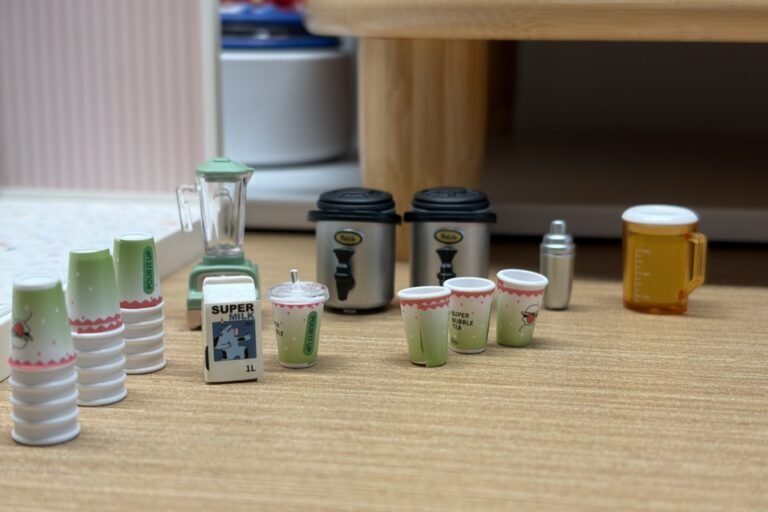
If you see lots of loose fabric, paper, wire, beads, and raw furniture components in the product photo, expect more traditional crafting.
Which One Is Easier If You Are Nervous About Tiny Parts?
This one is closer.
Both contain tiny parts.
But a modern assembly-focused book nook can reduce how many tiny components you need to manufacture.
You may still need to place little decorations, but you are less likely to spend an evening folding twenty books or making flower stems.
If handling very small parts is your biggest concern, I would choose the project with:
larger structural components,
fewer handmade decorations,
and more pre-finished details—
regardless of whether the finished model is labeled a book nook or miniature house.
Which One Is Better If You Want a Screen-Free Hobby After Work?
This depends on what kind of relaxation you like.
If your brain is tired and you want something fairly structured, a snap-fit book nook may be easier to return to after work.
The instructions tell you exactly what to do next.
Find piece C12.
Connect it to C13.
Continue.
There is less decision-making.
A craft-heavy miniature can demand more:
cut this accurately,
wait for that to dry,
shape this wire,
align this fabric,
decide how to position that object.
For some people, that extra handwork is exactly what makes the hobby absorbing.
For others, it turns relaxation into another task.
So ask yourself:
Do I relax more when I’m assembling—or when I’m making?
That question may predict your preference better than any difficulty rating.
Which One Is Better for Perfectionists?
Possibly the book nook.
But there is a catch.
Assembly-focused kits provide more fixed reference points.
A tab either fits.
A wall either aligns.
A sticker has an obvious location.
That structure can reduce the number of subjective decisions.
Traditional miniature houses contain more opportunities to notice:
the book is slightly crooked,
the fabric is not perfectly smooth,
the chair is not exactly square,
or your handmade flower looks different from the photograph.
Of course, the healthiest long-term solution may be accepting that a handmade miniature is allowed to look handmade.
But if you know small imperfections will bother you during your first project, a more structured build can feel easier.
Which One Is Better If You Want to Customize Later?
I would lean toward a miniature house.
Not because you cannot customize a book nook—you absolutely can.
But open miniature rooms naturally encourage it.
Once you understand the structure, you can start changing the scene.
Maybe the original design is a café.
You turn it into a tiny craft room.
A bedroom becomes a reading room.
A flower shop gains handmade crochet pieces.
A bookshelf gets miniature versions of your favorite books.
This is where miniature houses begin moving toward the wider world of dollhouse miniatures, dioramas, and scratch building.
If you suspect the kit is just your way into that larger hobby, the miniature house may teach you more reusable skills.
What About Lighting?
Lighting is important in both formats.
But it often plays a particularly important role in book nooks.
A book nook is dark by design.
It sits between books, surrounded by side walls.
Without internal lighting, much of the depth effect disappears.
That is why LEDs are such a prominent feature of the category.
For beginners, this means:
do not ignore the lighting system when comparing kits.
A simple pre-wired system is ideal.
Several tiny manually connected lamps add another layer of difficulty.
If wiring is one thing making you hesitate, connect this section to:
How to Wire Miniature House Lights Without Getting Lost.
The important habit is the same whichever format you choose:
test the lights before you permanently hide the wires.
Book Nook vs Miniature House: What I Would Choose First
If somebody told me:
“I have never built anything miniature before. I just want to see whether I enjoy the hobby.”
I would usually send them toward a beginner-friendly, mostly snap-fit book nook.
Not because book nooks are always better.
Because they tend to isolate the core experience.
You learn:
how miniature instructions work,
how laser-cut wood feels,
how much pressure tabs need,
how to handle small pieces,
how lighting fits into the structure,
and whether you actually enjoy several hours of detailed assembly.
Then you know more about yourself.
If you finish and think:
“I loved the building, but I wish I’d made more of the tiny objects myself,”
your next project should probably be a miniature house.
If you think:
“That was perfect. Give me another 3D puzzle with lights,”
buy another book nook.
There is no need to graduate from one to the other.
They can simply become two different versions of the hobby.
What If You Already Love Crafting?
Then I would change the recommendation.
If you already spend your time doing:
paper crafts,
crochet,
sewing,
model making,
wooden puzzles,
jewelry,
painting,
or detailed DIY,
you may have no reason to simplify your first miniature experience.
You already understand:
patience,
small components,
adhesive,
working in stages,
and the reality that handmade objects rarely come together instantly.
In that case, choose whichever finished scene excites you more.
A traditional miniature house may actually feel more rewarding because it gives those existing craft skills something new to do.
What If You Have Very Limited Time?
Book nook.
More specifically, a shorter beginner-friendly one.
A recent builder who had previous miniature experience completed a first book nook over a weekend and found it less time-consuming than expected.
Again, that does not apply to every model.
But the narrow, pre-engineered structure makes the category particularly suitable for contained weekend projects.
Traditional miniature kits can be equally enjoyable when done in short sessions, but they are more likely to remain open on your desk while glue dries and individual objects wait to be finished.
What If You Have Very Limited Space?
This is the easiest decision in the article.
Book nook.
That is literally what the format was designed to solve.
Your bookshelf becomes the display case.
And if you become addicted to the hobby—which miniature communities seem to regard as a fairly predictable outcome—you can fit several projects into a relatively small area.
A miniature house is better if you enjoy seeing the whole scene and already have somewhere appropriate to display it.
What If You Cannot Decide?
There is actually a third option.
Choose a hybrid kit.
Some modern projects combine the narrow display logic of a book nook with more traditional miniature-making elements.
You still get:
a defined structure,
a clear build sequence,
and a relatively contained scene,
but you also make some of the:
furniture,
plants,
books,
or decorations.
This middle ground comes up in beginner discussions too. Some builders specifically recommend starting with book nooks that contain a few handcrafted 3D elements before moving into more complicated miniature builds.
For someone genuinely interested in both experiences, that may be the ideal first project.
A Simple Decision Rule
If you are standing between two boxes and still cannot choose, use this:
Choose the book nook if you are most excited about the finished scene.
Choose the miniature house if you are most excited about making the tiny things inside it.
That is obviously a simplification.
But I think it gets closer to the real difference than:
“This one goes between books.”
The finished format matters.
The process matters more.
FAQ
What is the main difference between a book nook and a miniature house?
A book nook is traditionally a narrow miniature scene designed to fit between books on a shelf and is mainly viewed from the front. A miniature house is usually a more open, freestanding room or building designed for display.
The construction experience also frequently differs: many modern book nooks emphasize puzzle-like assembly, while traditional miniature houses often contain more handmade furniture, paper, fabric, and decorative work.
Are book nooks easier than miniature houses?
Often, but not automatically.
A beginner-friendly snap-fit book nook can be significantly easier than a craft-heavy miniature house.
But a detailed book nook with extensive gluing, handmade decorations, and complicated lighting can be harder than a simple miniature room.
Construction style matters more than category.
Should a complete beginner start with a book nook?
For many people, yes.
A mostly snap-fit beginner book nook provides a structured introduction to wooden parts, instructions, small pieces, and LED lighting without necessarily requiring extensive miniature crafting.
Real builders who have tried both formats frequently recommend this path for people who want a gentler introduction.
Which takes longer: a book nook or a miniature house?
Traditional detailed miniature houses often take longer because more furniture and decorations may need to be handmade.
However, complexity varies enormously.
A detailed book nook can take longer than a simple snap-fit miniature room.
Which is better for adults?
Both.
The better choice depends less on age and more on whether you prefer structured assembly or detailed crafting.
Book nooks are particularly attractive if you like puzzles, bookshelves, and dramatic lighting.
Miniature houses are particularly satisfying if you enjoy room design, furniture, handmade objects, and customization.
Do book nooks require glue?
Some do and some do not.
Modern designs increasingly use snap-fit construction, pre-cut adhesive, or a combination of mechanical connections and glue.
Always check the individual kit rather than assuming all book nooks are glue-free.
Are miniature houses better for customization?
Usually, yes.
Their more open structure gives you more freedom to move furniture, change colors, add handmade objects, and redesign the room.
Book nooks can also be heavily customized, but the narrow enclosure places more physical constraints on the scene.
Which one is easier to display?
Book nooks generally require less dedicated display space because they are designed to sit between books.
Miniature houses usually need an open shelf, desk, cabinet, or another surface where the interior remains visible.
Which one is better as a first screen-free hobby?
If you want a structured project after work, I would lean toward a beginner-friendly book nook.
If you already enjoy hands-on crafts and want the process of making tiny objects to occupy your attention, a miniature house may be more rewarding.
Final Thoughts
Book nooks and miniature houses look like close relatives.
They are.
But once you start building, their personalities become clearer.
A book nook often says:
“Let’s build this tiny world.”
A traditional miniature house often says:
“Let’s make the things that belong in this tiny world.”
One gives you more structure.
The other often gives you more craft freedom.
One disappears neatly between books.
The other asks for its own little corner of your room.
One may be finished over a weekend.
The other may quietly live on your desk for several weeks.
And neither experience is inherently better.
If you have never built a miniature before and simply want the smoothest introduction, I would usually begin with a beginner-friendly book nook that uses mostly pre-finished, snap-fit construction.
Then see what you miss.
If you find yourself wishing you had made the tiny furniture instead of simply assembling it, your next project is waiting for you:
a miniature house.
But if you switch on the lights, slide your finished book nook between two novels, and immediately start searching for another one—
there is no requirement to move on.
You have already found your version of the hobby.